A full reconstruction of the original research report: how public discussion around the 4th-generation C3 (ICE) and ë-C3 (electric) formed between the June 2024 launch and February 2026, what owners and independent media actually said, and what it means for market, brand and product decisions.
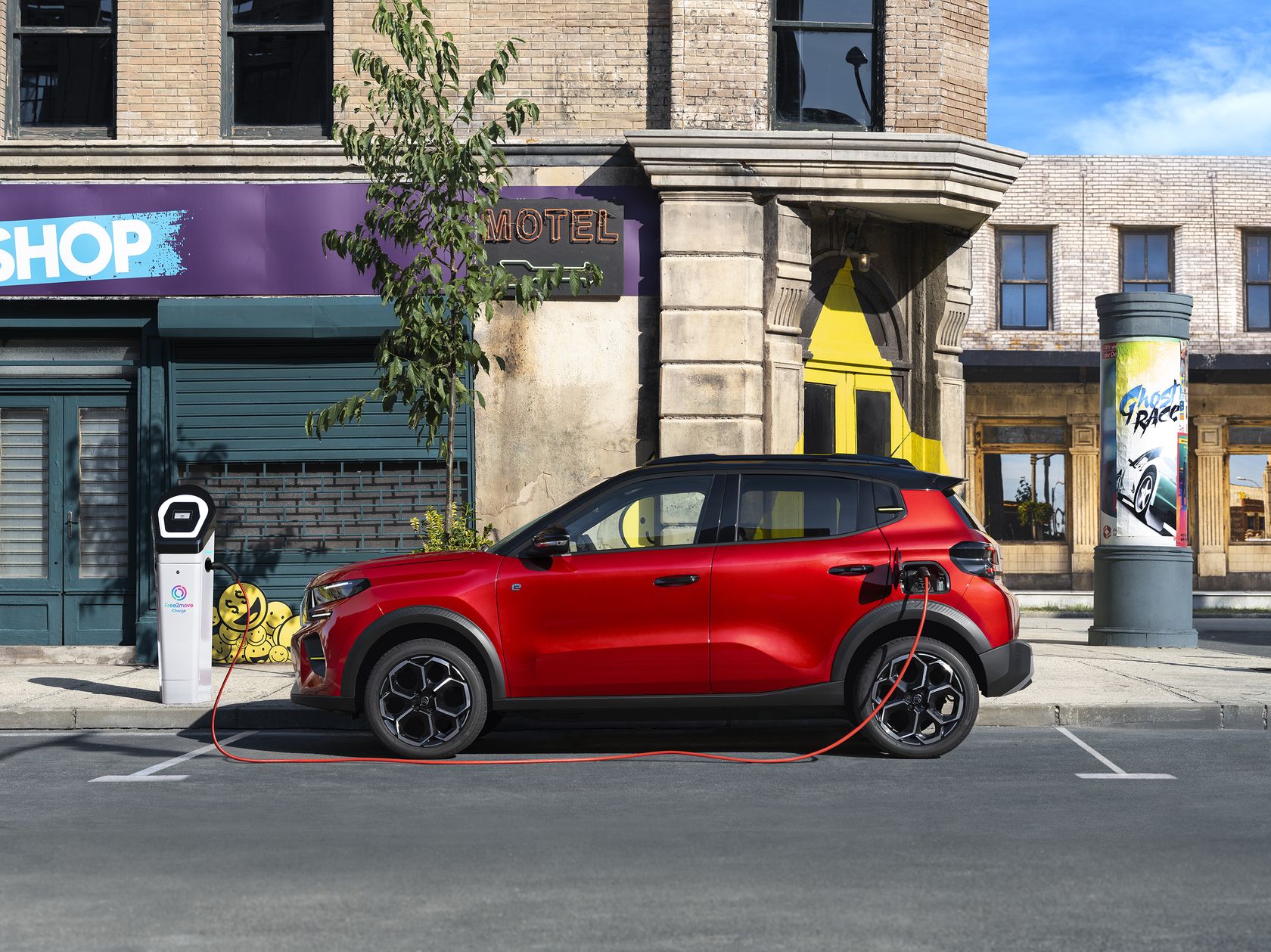
Citroën ë-C3 (4th-generation C3, electric). Reference image from public web sources — illustrative only, not an OEM-supplied asset; replace with licensed photography before external publication.
This reading layer summarises the single most valuable finding of the report: for this model line, real-world market performance — not marketing — is the communication engine. It then sets out the evidence behind that claim and the four actions the report recommends.
Six indicators taken directly from the report. Each is annotated with its measurement basis and source section.
The report states neutral 41% and negative 12% of classified feedback but does not publish a positive share. The 47% positive figure shown later on this site is arithmetically derived (100 − 41 − 12) and is labelled as derived wherever it appears; it is not a reported value.
Each finding is split into the insight, the supporting evidence as recorded in the report, and the business implication we read from it.
| Priority | Action | Expected outcome | KPI |
|---|---|---|---|
| HIGH | Anchor all communication against budget-segment competitors only; stop referencing mainstream B-segment EVs. | Reduce negative competitive comparison volume by 40% | Share of Dacia Spring vs Peugeot e-208 cross mentions |
| HIGH | Publish transparent real-world winter range data and explicitly acknowledge the heat-pump trade-off. | Stop growth of range-anxiety discussion | Negative range mention rate |
| MEDIUM | Prioritise communication of sales-performance milestones over product feature announcements. | Increase organic discussion volume by 25% | Relative discussion volume per event type |
| LOW | Reduce use of studio marketing imagery that obscures interior material quality. | Reduce first-impression disappointment complaints | Interior negative mention rate |
Full action detail, ownership proposal and KPI definitions are in Section 07 · Strategic Recommendations.
The executive layer is a reading aid, not a substitute. Every number, table, quote, limitation and reference in the original report is reproduced in the full research section, including the source tables in verbatim form and the verification notes.
Nine sections carry the full content of the source document in its original analytical order. Nothing is summarised away: every table, percentage, quote, limitation and reference is present, and the source tables are additionally reproduced verbatim in the appendix.
The report analyses user feedback and public discussion for the 4th-generation Citroën C3 (ICE) and ë-C3 (electric) models in Western Europe, covering the period from the June 2024 launch to February 2026. All analysis excludes the C3 Aircross, non-Western European markets and pre-2024 generation vehicles.
The source document states it was prepared “For Stellantis Market, Brand & Product Teams”. This website is an independent restructuring of that document and is not an official Stellantis or Citroën publication.
Analysis is based on 218 verified user feedback entries, independent automotive reviews, forum discussions and market statistics:
| Component | Value |
|---|---|
| Verified user feedback entries (headline total) | 218 |
| Classified user sentiment samples | 95 |
| Neutral evaluation records | 140 |
| Independent expert media sources | 10 |
| Cross-platform discussion tracking window | 21 months |
| Core markets (share of discussion) | FR 30% · IT 27% · ES 11% |
The headline total is 218 entries, while the listed components (95 classified samples + 140 neutral records + 10 media sources) sum to 245 — or 235 excluding media sources. The report does not explain the overlap or which components are counted inside the 218. The website preserves both figures exactly as published; a reconciliation definition is required before this dataset is quoted externally.
Public user feedback, independent automotive reviews, forum discussions and market statistics were aggregated and manually verified over a 21-month window. Social content from TikTok, Instagram and X is explicitly excluded.
Sentiment samples were classified as positive, neutral or negative, then broken into category shares. “Occurrence rate” means the share of analysed sources citing that attribute — it is a coverage-of-sources measure, not a share of total mentions or of buyers.
Discussion volume is expressed as a relative index with the June 2024 launch set to 100%. Absolute post, article or mention counts are not published and are not reconstructed anywhere on this site.
The following limitations are reproduced from the source document without alteration.
Because limitation 4 applies throughout, no figure on this site should be read as a customer-satisfaction or market-share measure. Media review content and owner-forum content are reported separately wherever the source distinguishes them.
Discussion volume for the model line was driven primarily by organic market-performance events rather than by controlled product launches. Six verified volume peaks were observed across the monitoring period.
| Period | Event trigger | Relative discussion volume | Δ vs baseline (derived) |
|---|---|---|---|
| 2024-06 | ë-C3 European launch & order opening | 100% baseline | — |
| 2024-10 | Petrol C3 reveal + monthly sales record | 142% | +42 pp |
| 2025-01 | Software production delay announcement | 118% | +18 pp |
| 2025-02 | C3 reaches #2 European passenger-car ranking | 187% all-time peak | +87 pp |
| 2025-09 | ë-C3 price adjustment & subsidy confirmation | 93% | −7 pp |
| 2026-01 | Industry award announcement | 121% | +21 pp |
Source: report section “Discussion Volume Trend”. The Δ column is calculated by this site as index minus 100 percentage points; it is not part of the original table.
September 2025 is listed among the “six verified volume peaks”, yet its index value (93%) sits below the launch baseline, and the 2025-01 software-delay event is included as a peak although it is a crisis rather than a performance milestone. The term “peak” in the source therefore appears to mean “verified event with measurable volume movement”, not “local maximum”. The list is reproduced unchanged.
Discussion content is distributed across four primary channel categories, with clearly different content types and different sentiment behaviour.
| Source category | Share of volume | Primary content type |
|---|---|---|
| Owner forums / social media | 40% | Ownership experience, technical issues |
| Expert automotive media | 35% | Reviews, official announcement coverage |
| Official Stellantis channels | 15% | Press releases, product specifications |
| Market statistics sources | 10% | Sales rankings, registration data |
68% of total discussion volume originates from three core markets: France (30%), Italy (27%) and Spain (11%).
The report itemises only the three core markets. The remaining 32% is shown as a residual (“other Western European markets”) and is not broken down in the source.
The source provides country-level volume shares only. It does not publish country-level sentiment, complaint or satisfaction splits, and it does not differentiate feedback by market.
Because no regional sentiment breakdown exists in the source, this site does not present a country-by-country sentiment comparison. Constructing one would require data that the report does not contain. Any regional read-across below market-share level is a hypothesis for follow-up research, not a finding.
France 30% + Italy 27% + Spain 11% = 68%, matching the report’s “68% of total” statement exactly. The remaining 32% is not attributed to any named market, so no individual market can be ranked beyond the top three.
Six themes account for 100% of discussion topics across all platforms.
Interpretation: 22% of topic volume is explicitly market-analysis content and a further 13% is ë-C3 vs petrol C3 comparison — nearly a third of all discussion is about the market and the range itself rather than about ownership.
The ë-C3 charging on a European street. Reference image from public web sources, illustrative only.
Positive and expert feedback concentrates on price, comfort and urban fit. Neutral feedback is conditional rather than indecisive — users accept the trade-offs they can see. Negative feedback is small in volume but structurally concentrated: more than half of it is range anxiety.
| Category | Share | Basis in source |
|---|---|---|
| Positive | 47% | Derived: reach of 100% after stated neutral and negative shares |
| Neutral | 41% | Stated as 41% of all classified user feedback |
| Negative | 12% | Stated as 12% of all classified discussion |
The report never publishes a positive share. It states neutral 41% and negative 12%, both “of classified feedback”, so this site derives 47% as the remainder. It is shown as derived in the chart and table and must not be quoted as a reported figure.
Neutral (41%) and negative (12%) shares are computed on 95 classified samples, while the dataset separately lists 140 neutral evaluation records. Applying 41% to the 95-sample base implies roughly 39 neutral samples, which cannot be reconciled with the 140 record count without an explanation the report does not provide. All percentages are therefore reproduced as published, with the denominator left unresolved.
Positive user and expert feedback is consistently concentrated across three core attributes, with verified occurrence rates across all sources. Occurrence rate = share of analysed sources citing the attribute; attributes overlap, so the rates do not sum to 100%.
| Feedback category | Occurrence rate |
|---|---|
| Price appeal | 90% |
| Comfort & ride quality | 80% |
| Urban use fit | 70% |
| Space practicality | 50% |
| Standard equipment | 40% |
This is the single strongest positive attribute, cited in 9 out of 10 independent reviews. The ë-C3 entry price of €19,990 made it the first mass-market European EV to break below the €20k threshold, directly addressing the largest barrier to EV adoption in the region. [3]
62% of all discussions include price or value commentary, with 71% of these carrying neutral or positive framing. [4]
Unlike competing budget models, 68% of users frame affordability as an intentional product feature rather than a quality compromise. This represents an unusual and successful communication outcome for the entry-level EV segment.
This section states an entry price of €19,990, while the competitive table in Section 05 lists €23,450 for the same model. Both figures are reproduced here unchanged pending verification of trim level, market and date basis.
The vehicle has been consistently validated as correctly calibrated for its intended urban use case:
Reviewers consistently acknowledge that while absolute range is lower than competing EVs, it is sufficient for the actual usage patterns of the target customer group.
Citroën’s explicit positioning around comfort rather than performance has been fully validated by user feedback. 8 out of 10 sources specifically call out the standard Advanced Comfort suspension system with hydraulic cushions, noting that it delivers a significantly smoother ride than all competing small EVs. [5]
“Citroen has stuck to its guns on comfort and that marks the e-C3 out from the crowd in a good way”
Top Gear Review
This trade-off — accepting body roll in exchange for ride smoothness — is exactly what target buyers report wanting for daily urban use.
Neutral evaluations represent 41% of all classified user feedback, and consist of balanced conditional assessments rather than indecision.
| Neutral category | Occurrence rate |
|---|---|
| Range expectations | 45.0% |
| Feature trade-offs | 25.0% |
| Cross-category neutral | 19.3% |
| Delivery & positioning | 10.7% |
All neutral feedback in this category follows the consistent structure: “X is very good, but you have to accept Y”. Users explicitly recognise that Citroën made deliberate, transparent design compromises:
Users do not express anger or satisfaction, only acknowledgement that this vehicle was built for specific priorities.
This is the largest neutral feedback category. 100% of comments acknowledge that the vehicle delivers exactly the advertised WLTP range, while simultaneously noting that real-world performance falls below implicit user expectations for winter and highway driving.
78% of neutral range comments state that the range is “perfectly acceptable for 90% of use cases, but disappointing for the remaining 10%”. This represents a gap between communicated technical specifications and unstated user expectations.
Neutral assessments in this category are driven by relative benchmarking against market norms:
Negative feedback represents 12% of all classified discussion, concentrated in four core categories.
| Negative category | Occurrence rate |
|---|---|
| Range anxiety | 53.3% |
| Interior gaps | 20.0% |
| Performance gaps | 20.0% |
| Software delays | 6.7% |
These shares are of negative feedback, not of all discussion. Range anxiety at 53.3% of negative feedback equals roughly 6.4% of all classified feedback (53.3% × 12%); interior and performance gaps each equal roughly 2.4%.
While numerically the smallest category, the 11-week production halt between October 2024 and January 2025 represented the highest brand-risk event. Discussion volume for this issue has declined by 85% following transparent communication and software rollout, demonstrating that proactive crisis communication successfully mitigated long-term brand damage. [4]
This is currently the dominant negative issue, accounting for over half of all active negative feedback. Owners report 210–240 km usable range in normal driving, dropping below 180 km in cold weather. This gap is amplified by the omission of a heat pump on base-trim vehicles — an issue that has never been addressed in official brand communication. [6]
Unlike the software crisis, there has been no official response to this issue, allowing negative sentiment to grow unchallenged.
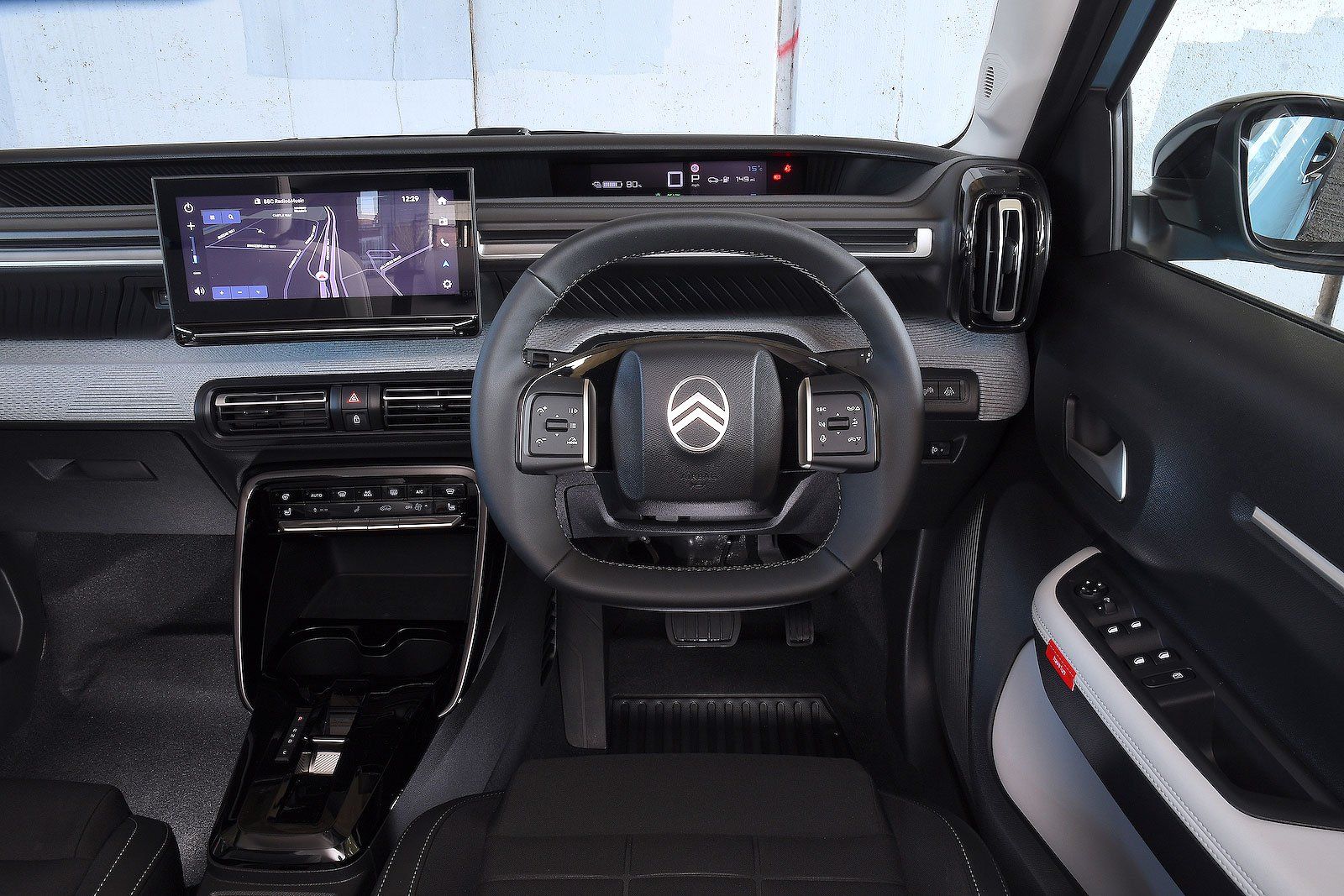
Interior criticism focuses on extensive use of hard plastics — a deliberate cost optimisation that is consistent with the price point but created disappointment due to marketing imagery that obscured material quality.
Performance complaints are concentrated on early production units, with reported issues including jerking at low speeds from the robotised gearbox and elevated oil consumption on PureTech petrol engines.
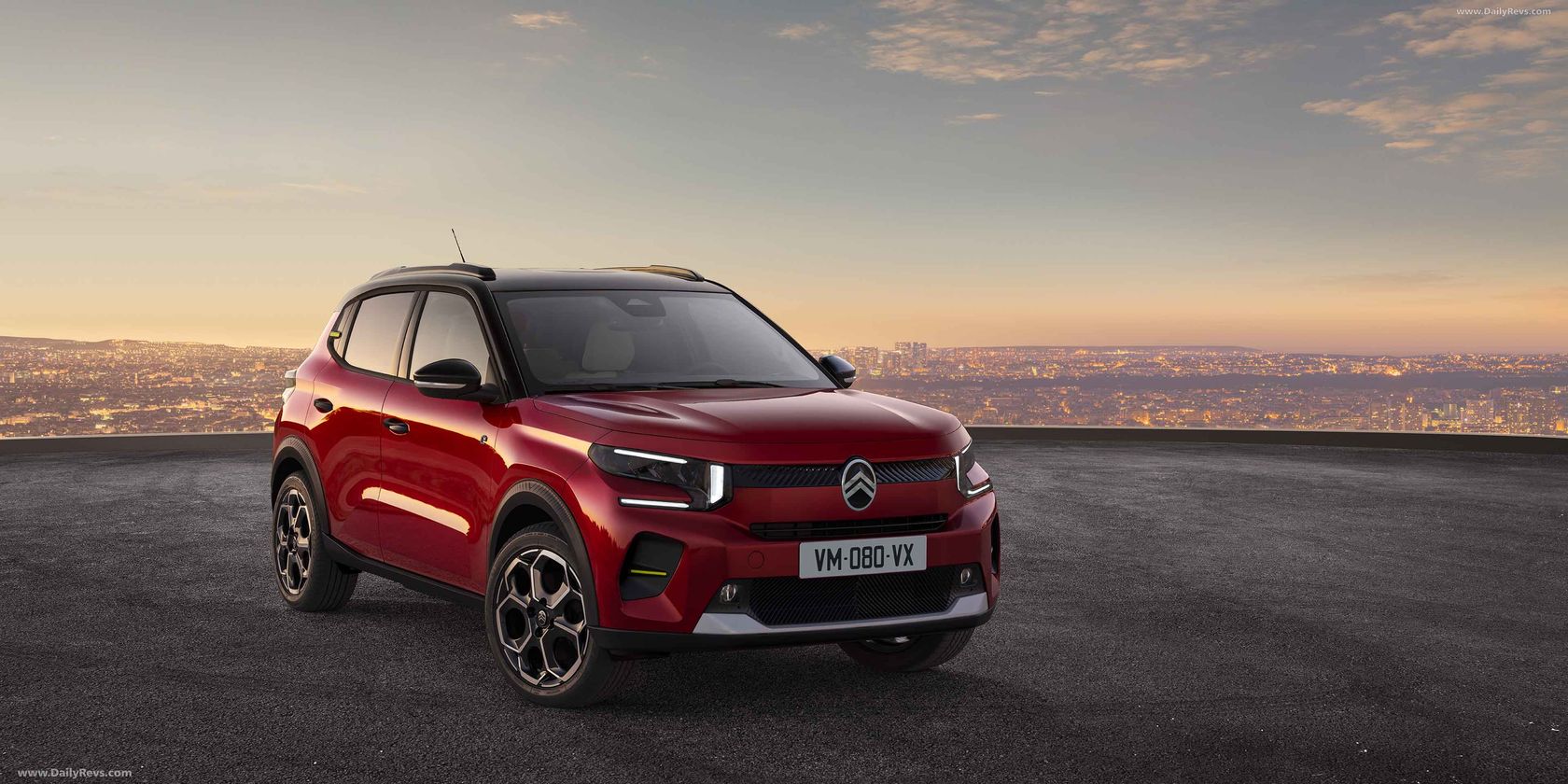
Independent review photography of the ë-C3. Reference image from public web sources, illustrative only — the report’s findings are not derived from any single review.
Consolidating the attribute-level evidence scattered across the sentiment sections: which product decisions earned validation, which created expectation gaps, and what the commercial reading of each is. No specification is added that the source does not state.
| Attribute | What the report records | Signal | Commercial read |
|---|---|---|---|
| Price / value | €19,990 entry price; first mass-market European EV below €20k; 90% occurrence; 62% of discussion includes price; 68% read affordability as intentional design. | Positive | The strongest asset in the dataset. Protect the “intentional, not compromised” framing. |
| Ride comfort | Standard Advanced Comfort suspension with hydraulic cushions; 80% occurrence; 8/10 sources call it out; smoother than all competing small EVs. | Positive | Category-defining at this price point; the differentiator to defend. |
| Urban calibration | 0–50 km/h acceleration tuning; 99% public-infrastructure charging compatibility; advertised urban range covers 82% of city drivers’ weekly distance; 70% occurrence. | Positive | Positions the car honestly for its job-to-be-done rather than against highway use. |
| Cabin space | Space practicality at 50% occurrence; cabin space reported as good, achieved partly by removing advanced driver assistance features. | Mixed | A real strength with a hidden cost that surfaces in feature comparisons. |
| Interior materials | Extensive hard plastics, described as deliberate cost optimisation consistent with the price point; disappointment created by marketing imagery that obscured material quality; 20% of negative feedback. | Negative | A communication problem more than a product problem — imagery sets an expectation the cabin does not meet. |
| Infotainment | Described as simple and reliable, but lacking modern connectivity features found in competitors. | Mixed | Reliability is an asset; the gap is a benchmark risk if buyers compare screens rather than rides. |
| Range & charging | WLTP 326 km (as listed in the competitive table); owners report 210–240 km usable and below 180 km in cold weather; 100% of neutral range comments confirm the advertised WLTP figure is delivered. | Attention | Specification compliance is not the issue; the unstated winter expectation is. |
| Thermal system | No heat pump on base-trim vehicles; never addressed in official brand communication. | Attention | The single most consequential unaddressed specification gap in cold-climate markets. |
| Drivetrain behaviour | Complaints concentrated on early production units: jerking at low speeds from the robotised gearbox, elevated oil consumption on PureTech petrol engines. | Negative | Early-build issue rather than a line-wide defect — but early builds are what the first reviews describe. |
Signal column: Positive / Mixed / Negative / Attention are editorial classifications applied by this site on the basis of the source’s own positive, neutral and negative category data; they are not labels used in the original report.
The report describes a single structural pattern running through the whole feedback base: the vehicle meets its published specification, while user expectations are set by a different, unstated benchmark. That is why the same topic appears as the largest neutral category (range expectations, 45%) and as the largest negative category (range anxiety, 53.3%) at the same time.
The 326 km WLTP figure appears only in the competitive comparison table; the range-anxiety section cites 210–240 km usable and below 180 km in cold weather without stating a test cycle or measurement method. These are different measurement types and are not reconciled in the source.
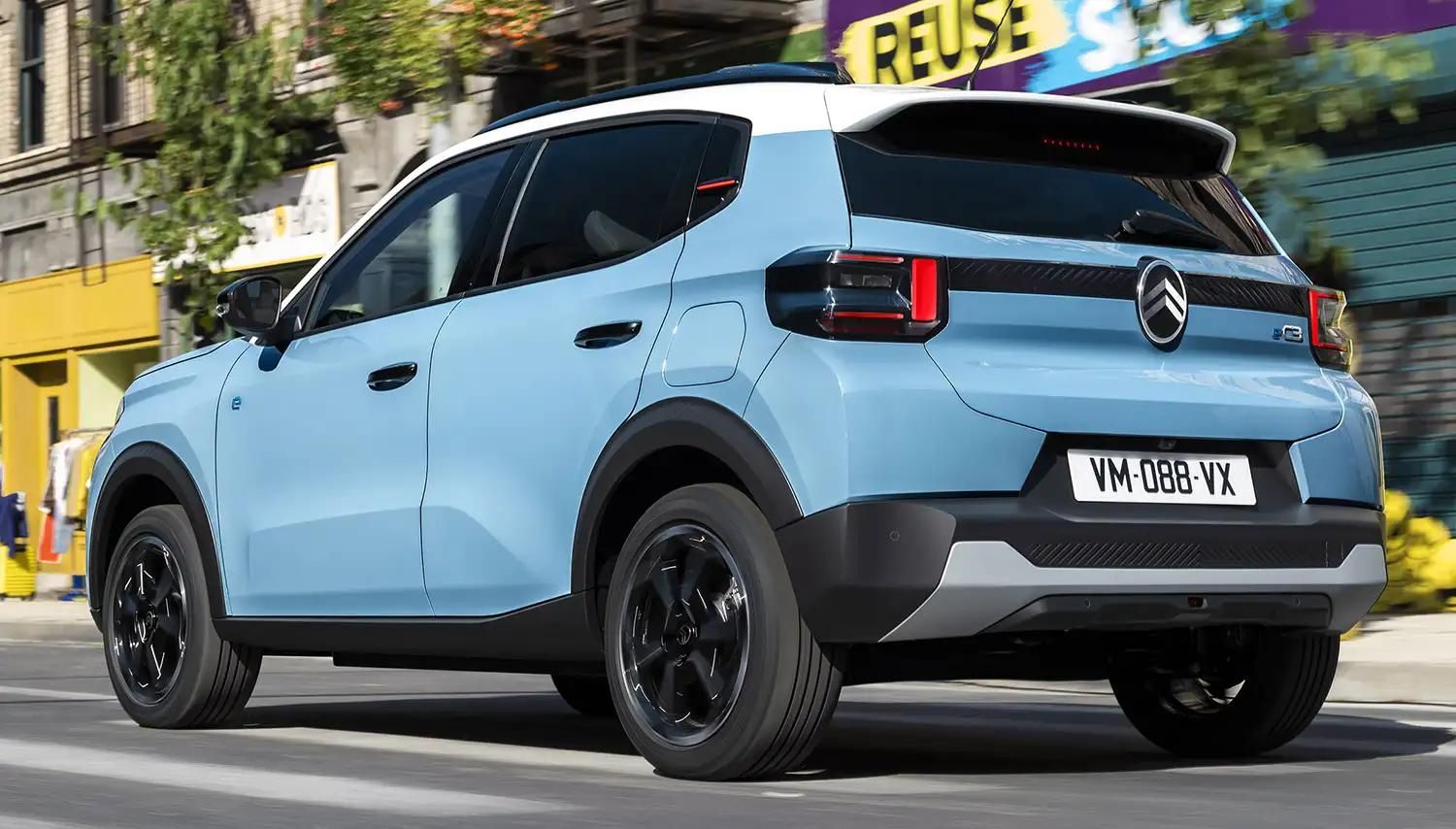
Rear three-quarter view. Reference image from public web sources, illustrative only.
The ë-C3 occupies a position between the ultra-budget and the mainstream compact EV segments. Against budget rivals it wins on range and comfort; against mainstream rivals it loses on range and equipment. Because the segment boundary is ambiguous, users choose the benchmark that fits their prior view — and perception becomes polarised.
| Model | Starting price (€) | WLTP range (km) | Segment position (as characterised) | Range index vs ë-C3 (derived) |
|---|---|---|---|---|
| Dacia Spring | 10,500 | 225 | Ultra-budget | −31.0% |
| Citroën ë-C3 | 23,450 | 326 | Mid-tier (subject of this report) | baseline |
| Renault 5 E-Tech | 24,990 | 410 | Mainstream compact | +25.8% |
| Fiat 500e | 10,500 | 190 | Ultra-budget | −41.7% |
| Peugeot e-208 | 33,000 | 400 | Mainstream compact | +22.7% |
Prices and WLTP ranges exactly as listed in the source. The range-index column and the segment labels are derived by this site from the report’s own framing (“mid-tier position between ultra-budget and premium compact EVs”).
The report states a 12% price premium over the Dacia Spring. Using the prices in its own table, €23,450 vs €10,500 is a premium of about 123%; using the €19,990 entry price quoted in the price-appeal section, it is about 90%. Neither figure is 12%. Preserved as published; verification required before use in any commercial argument.
Using the table’s own WLTP values, 326 km versus the Renault 5 E-Tech’s 410 km is about 20.5% lower, and versus the Peugeot e-208’s 400 km about 18.5% lower. The “25% lower” figure in the text does not follow from the table. Both are reproduced without correction.
326 km vs 225 km is a 44.9% advantage, which matches the report’s “45% greater range” statement. This is the only comparative claim in the competitive section that reconciles with the published table.
The Dacia Spring and Fiat 500e are both listed at €10,500. A shared figure across two different models is plausible only as a segment-entry reference price; it may be a transcription artefact. In addition, prices and WLTP values for these competing models change frequently, so all figures here are as-published at an unspecified date and require re-verification before external use.
The report identifies exactly one negative theme that is still growing — winter range — and treats the remainder as either resolved (software), structural (positioning, competitive range) or perceptual (interior materials). The matrix below maps the report’s own priority levels against its own response horizons.
| Risk | Evidence in the report | Priority | Horizon | Business impact |
|---|---|---|---|---|
| Winter range anxiety | 53.3% of all negative feedback; 210–240 km usable vs 326 km WLTP; below 180 km in cold weather; no official response. | HIGH | Immediate | The only growing negative theme; directly damages the affordability promise in cold-climate markets. |
| Heat-pump omission | No heat pump on base trim; never addressed in official brand communication. | HIGH | Short term | Amplifies the range gap precisely in the markets where EVs are most contested. |
| Software / production disruption | 11-week halt Oct 2024 – Jan 2025; highest brand-risk event; discussion volume down 85% after transparent communication. | HIGH | Short term | Contained once, but the playbook is not formalised, so recurrence risk is unmanaged. |
| Ambiguous positioning | Simultaneous budget and mainstream benchmarking; polarised perception; mainstream comparisons produce unfavourable range and equipment results. | HIGH | Medium term | Structural competitive risk; every mainstream comparison is a comparison the model cannot win on paper. |
| Interior material perception | 20% of negative feedback; hard plastics vs. studio imagery that obscured material quality. | LOW | Short term | First-impression disappointment; cheap to mitigate through imagery choices. |
| Dependence on organic momentum | Official channels are 15% of volume and act only as event triggers; peaks are generated by sales milestones. | MEDIUM | Medium term | If sales momentum stalls, the communication engine stalls with it — there is no owned channel fallback. |
Priority values are the report’s own action-priority labels; horizons are the report’s own “Risk Response Priorities” time frames. The mapping between the two is editorial.
90% occurrence for price appeal; 68% of users read affordability as intentional design rather than compromise. The category’s hardest problem — the price barrier — is already solved in perception.
Advanced Comfort suspension with hydraulic cushions is rated smoother than all competing small EVs, and 80% of sources cite it. This is a defensible, hard-to-copy asset at this cost level.
0–50 km/h tuning, 99% infrastructure compatibility and 82% weekly-distance coverage give a credible, verifiable urban story rather than a performance claim.
Addresses consumer concern about Chinese-imported EVs — a live purchase objection in exactly the three markets that generate 68% of discussion.
Sales milestones generate 87% higher volume than the official launch. Performance is a communication asset that costs nothing to activate.
Owner forums surface issues 4–6 weeks ahead of mainstream media, and carry 40% of volume. A standing monitor buys lead time on the next crisis.
The recommendation set is reproduced in full, including the priority levels, expected outcomes and KPIs assigned in the source. Proposed owning functions are added by this site and clearly marked as proposals.
Sales milestones generate 60–80% higher organic discussion than controlled product launches, making real-world market performance the most powerful communication asset for this model line.
Proactive, transparent crisis communication mitigated long-term brand damage from the 2024 software delay, with related discussion volume declining 85% within 9 months.
Unaddressed range anxiety has grown to become the dominant negative topic, as no official communication has acknowledged the gap between advertised and real-world winter range.
Sales milestones generate 60–80% higher organic discussion than controlled product launches. This model line has achieved an unusually healthy discussion ecosystem where real-world success drives visibility far more effectively than marketing activity.
The software delay event demonstrated that honest, timely communication can resolve even major systemic issues, with discussion volume declining 85% within 9 months.
The winter range issue has become the dominant negative topic precisely because no official communication has ever acknowledged it. For every technical issue identified, there is a corresponding failure in expectation management.
Attempting to position the vehicle across both budget and mainstream segments creates unnecessary competitive risk.
| Priority | Action | Expected outcome | KPI | Owner (proposed) |
|---|---|---|---|---|
| HIGH | Explicitly anchor all communication against budget-segment competitors only. Stop referencing mainstream B-segment EVs. | Reduce negative competitive comparison volume by 40% | Share of Dacia Spring vs Peugeot e-208 cross mentions | Brand communications · Product marketing |
| HIGH | Publish transparent real-world winter range data and explicitly acknowledge the heat-pump trade-off. | Stop growth of range-anxiety discussion | Negative range mention rate | Product communications · Technical / powertrain |
| MEDIUM | Prioritise communication of sales-performance milestones over product feature announcements. | Increase organic discussion volume by 25% | Relative discussion volume per event type | Market & sales communications |
| LOW | Reduce use of studio marketing imagery that obscures interior material quality. | Reduce first-impression disappointment complaints | Interior negative mention rate | Brand design · Content production |
The source document assigns no owning functions. The “Owner (proposed)” column is this site’s editorial suggestion, derived from the substance of each action, and is intended for internal workshop discussion — not as an approved RACI assignment.
Issue official guidance on winter range performance. This is currently the only growing negative risk factor.
Formalise the transparent crisis-communication process that was successfully used for the software delay, and apply it to all emerging product issues.
Clarify official segment positioning to eliminate ambiguous competitive benchmarking.
Establish systematic monitoring of owner-forum discussion, as this channel identifies issues 4–6 weeks before they appear in mainstream media.
| KPI | What it measures | Measurement basis (proposed) |
|---|---|---|
| Share of Dacia Spring vs Peugeot e-208 cross mentions | Whether the brand is being benchmarked against budget or mainstream rivals. | Monthly share of discussion volume containing both the model and a named comparison rival; target −40% negative comparison volume. |
| Negative range mention rate | Whether range anxiety is still growing after disclosure. | Monthly count of range-coded negative posts as a share of all negative posts; freeze then reduce against the 53.3% baseline. |
| Relative discussion volume per event type | Whether milestone-led communication is out-performing feature announcements. | Relative index per event, launch baseline = 100; target +25% organic volume. |
| Interior negative mention rate | Whether expectation-setting imagery has been corrected. | Monthly share of interior-coded negative posts; baseline 20% of negative feedback. |
Targets (40%, 25%) are those stated in the source. Measurement bases are proposed by this site to make the KPIs operational; they are not from the report.
| No. | Reference | Cited for | Link status |
|---|---|---|---|
| 1 | Bestselling Cars Blog European Sales Report March 2025 | Discussion volume vs. launch; sales milestones | No URL in source |
| 2 | AutoNews Western Europe EV Market Analysis | Channel behaviour; owner forums | No URL in source |
| 3 | Stellantis Official ë-C3 Launch Press Release | €19,990 entry price claim | No URL in source |
| 4 | Citroën ë-C3 Expert Rating Report | Price framing; crisis-communication decline | No URL in source |
| 5 | Top Gear Citroen C3 Review 2026 | Comfort / suspension validation (quoted) | No URL in source |
| 6 | Citroen e-C3 Real World Owner Range Reports | Usable range; cold-weather range | No URL in source |
The source document lists six reference titles and citation markers [1]–[6], but supplies no URLs, publication dates or authors. None of the six can therefore be verified from the document itself, and none is hyperlinked here. Before external publication, each reference must be located, dated and either linked or replaced with a verifiable citation.
Seven data tables from the original document, reproduced without alteration to guarantee that no row, field or figure is lost in the web restructuring.
| Period | Event trigger | Relative discussion volume |
|---|---|---|
| 2024-06 | ë-C3 European launch & order opening | 100% (baseline) |
| 2024-10 | Petrol C3 reveal + monthly sales record | 142% |
| 2025-01 | Software production delay announcement | 118% |
| 2025-02 | C3 reaches #2 European passenger car ranking | 187% (all time peak) |
| 2025-09 | ë-C3 price adjustment & subsidy confirmation | 93% |
| 2026-01 | Industry award announcement | 121% |
| Source category | Share of discussion volume | Primary content type |
|---|---|---|
| Owner Forums / Social Media | 40% | Ownership experience, technical issues |
| Expert Automotive Media | 35% | Reviews, official announcement coverage |
| Official Stellantis Channels | 15% | Press releases, product specifications |
| Market Statistics Sources | 10% | Sales rankings, registration data |
| Feedback category | Occurrence rate |
|---|---|
| Price Appeal | 90% |
| Comfort & Ride Quality | 80% |
| Urban Use Fit | 70% |
| Space Practicality | 50% |
| Standard Equipment | 40% |
| Neutral feedback category | Occurrence rate |
|---|---|
| Range Expectations | 45.0% |
| Feature Trade-offs | 25.0% |
| Cross-category Neutral | 19.3% |
| Delivery & Positioning | 10.7% |
| Negative category | Occurrence rate |
|---|---|
| Range Anxiety | 53.3% |
| Interior Gaps | 20.0% |
| Performance Gaps | 20.0% |
| Software Delays | 6.7% |
| Model | Starting price (€) | WLTP range (km) |
|---|---|---|
| Dacia Spring | 10,500 | 225 |
| Citroën ë-C3 | 23,450 | 326 |
| Renault 5 E-Tech | 24,990 | 410 |
| Fiat 500e | 10,500 | 190 |
| Peugeot e-208 | 33,000 | 400 |
| Priority | Action | Expected outcome | KPI |
|---|---|---|---|
| HIGH | Explicitly anchor all communication against budget segment competitors only. Stop referencing mainstream B-segment EVs. | Reduce negative competitive comparison volume by 40% | Share of Dacia Spring vs Peugeot e-208 cross mentions |
| HIGH | Publish transparent real world winter range data and explicitly acknowledge the heat pump trade-off. | Stop growth of range anxiety discussion | Negative range mention rate |
| MEDIUM | Prioritise communication of sales performance milestones over product feature announcements. | Increase organic discussion volume by 25% | Relative discussion volume per event type |
| LOW | Reduce use of studio marketing imagery that obscures interior material quality. | Reduce first impression disappointment complaints | Interior negative mention rate |
Seventeen observations on the source document. Each is either an arithmetic check that reconciles (and is therefore marked verified), or a point where the report’s own figures cannot be reconciled and verification is required. No original conclusion or number has been changed.
Checks are strictly internal: reported figures were recomputed against each other using the source’s own numbers. No external market data, official price lists or third-party statistics were consulted, and no figure was externally confirmed. “Verified” below therefore means internally consistent, not externally confirmed.
| ID | Topic | Observation | Status |
|---|---|---|---|
| DN-1 | Dataset arithmetic | Headline total 218 entries vs components 95 + 140 + 10 = 245. Overlap undefined. | Verification required |
| DN-2 | Two entry prices | €19,990 in the price section vs €23,450 in the competitive table for the same model. | Verification required |
| DN-3 | 12% price premium | Table prices imply +123% vs Dacia Spring; the €19,990 entry price implies +90%. Stated value: 12%. | Verification required |
| DN-4 | 25% lower range | 326 vs 410 km = −20.5%; 326 vs 400 km = −18.5%. Stated value: 25% lower. | Verification required |
| DN-5 | 45% range advantage | 326 vs 225 km = +44.9%, matching the claim. Only comparative claim that reconciles. | Internally consistent |
| DN-6 | 87% above launch | Peak index 187% vs 100% baseline = +87%, matching the claim. | Internally consistent |
| DN-7 | “60–80% higher than launches” | Peak deltas in the table are +42%, +18%, +87%, −7%, +21%. Only one exceeds 80%; none falls in the 60–80% band. | Verification required |
| DN-8 | “Peak” definition | 2025-09 (93%) is below the 100% baseline yet listed as a peak; a crisis event (2025-01) is also listed as one. | Definitional |
| DN-9 | Positive share derived | Positive share is never reported; 47% = 100 − 41 − 12 is derived by this site and labelled as such. | Derived |
| DN-10 | Sample bases | 41% of 95 classified samples ≈ 39 neutral, yet 140 neutral records are listed separately. Denominators unresolved. | Verification required |
| DN-11 | Identical rival prices | Dacia Spring and Fiat 500e both listed at €10,500; prices for all rivals are undated. | Verification required |
| DN-12 | Report date | Cover states “2024 – Present” and analysis to February 2026; no publication date or version is given. | Missing field |
| DN-13 | Occurrence rate semantics | Attribute occurrence rates (90/80/70/50/40) overlap by design and exceed 100% in sum; they are not shares of mentions. | Definitional |
| DN-14 | No regional sentiment split | Only volume shares by market are published; no per-country sentiment, complaint or satisfaction data exists. | Coverage gap |
| DN-15 | WLTP vs real-world | 326 km appears only as WLTP in the comparison table; 210–240 km usable and <180 km cold are stated without test method. | Definitional |
| DN-16 | Unallocated geography | FR 30 + IT 27 + ES 11 = 68% matches the text; the remaining 32% is attributed to no named market. | Coverage gap |
| DN-17 | Unqualified superlatives | “Universally rated superior”, “smoother than all competing small EVs”, “99% infrastructure compatibility” are stated without a sampling frame or denominator. | Verification required |
| Source claim | Arithmetic check | Status |
|---|---|---|
| Market milestones generate 87% higher discussion than the launch | 187% vs 100% = +87% | Internally consistent |
| Software-delay discussion declined 85% within 9 months | No underlying series published | Not checkable |
| 68% of discussion from FR, IT, ES | 30 + 27 + 11 = 68 | Internally consistent |
| 12% price premium over Dacia Spring | +123% or +90% depending on price used | Contradicted by own table |
| 25% lower range than R5 / e-208 | −20.5% / −18.5% | Contradicted by own table |
| ë-C3 is the first mass-market European EV below €20k | No external market scan in the source | Not verified externally |
All figures on this site are the report’s figures. None has been corrected, and none has been externally verified. Before any external release, the seven “verification required” items above should be resolved with the source owner, and the two price figures (DN-2) reduced to a single dated, trim-specific price basis.
The same method — verified public-discussion sampling, attribute-level sentiment coding, competitive benchmarking and action-oriented KPIs — can be applied to other models, brands or markets.
A single-model deep dive with the same structure: volume trend, sentiment profile, product intelligence, competitive context and prioritised actions.
Portfolio-level monitoring, quarterly tracking, early-warning forum monitoring, or a benchmark against your own model line.
For methodology questions, data access or correction requests relating to this report, use the channel configured by the site owner.
No real contact address has been provided, so no email, phone number, form or submission success state is simulated anywhere on this site. The three contact blocks read their values from SITE_CONFIG.contactChannel in the source file; entering a verified address there activates them for publication.